

Collision With the Infinite by Suzanne Segal
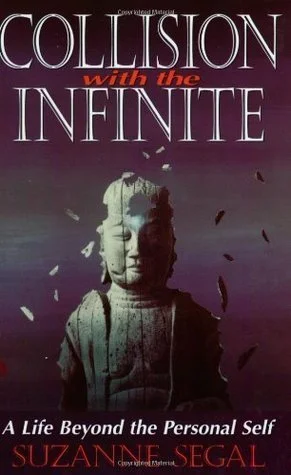
Suzanne Segal is standing at a bus stop in Paris, when her sense of personal self vanishes. ‘Collision with the infinite’ charts the terror, the confusion, the years of therapy and spiritual wandering that followed, until she realised she was living as the “vastness” that underlies all experience.
No-Self
Imagine standing at a bus stop, when all of a sudden your self disappears. This is what happens to Suzanne Segal, and the book recounts her attempt to continue living ‘her’ life, despite ‘her’ not existing.
Although it happens suddenly, she does have a history of some spirtual background. The early sections describe how even as a child, she had used her name as a mantra. Later in her teens in the US she develops an interest in Transcendental meditation (TM), going on long retreats and even meet the Maharishi. She eventually becomes disillusioned with this, and her spiritual practice has largely stopped before she disappears at the bus stop.
Spiritual Wintertime
Suzanne is on her way back from a trip to the doctor to check on her pregnancy when the incident occurs at the bus stop. This adds to the sense of terror, the feeling of depersonalisation.
“Life went on. The body functioned. Speech happened, eating happened, parenting happened, but there was no one doing it.”
What follows is ten years in a sort of limbo, her previous relationship and life falling apart, as she moves back to the states to try and work out what has happened to her, what particular psychological problem she is suffering.
It’s a long fourteen years, with relationships coming and going, but she does manage to achieve a psychology doctorate in this period. What’s most frustrating for her is the conveyor belt of therapists that she meets with, the years and years of therapy .
She’s desperate to find out what has happened to her, but is continually frustrated as therapists try to force her into various models, none of which answer her questions. A couple of times she feels that is understood, entering into a relationship with one psychologist, only to discover that they have completely misunderstood her.
Zen Buddhism and Advaita
Eventually, Suzanne begins to meet with spiritual teachers, most importantly with those who practice Zen Buddhism and Advaita. It’s only then that she begins to finally understand her experience in a spiritual context. This brings great relief, and she begins to offer her own weekly meetings and dialogues, even training therapists to help them understand what she had gone through. Sadly, she passes from cancer in 1997
“The idea that we have a self that controls, arbitrates, or is the doer behind our actions is absurd. The individual self is nothing but an idea of who we are.”
Books on Spiritual Awakening
I have compiled a list elsewhere of books on spiritual awakening, and there’s no doubt I’ll add this to it, a classic non-duality memoir. I’m continually picking up more books on spirituality, and this has been one of the most startling books on the subject I’ve read.
Saying that, the state of no-self is indescribable - it’s beyond mere words. Suzanne Segal makes this clear throughout the book, but her recounting of her experiences is probably as close as it’s possible to get. All the time she describes her life lucidly and with a straightforwardness that prevents it from ever feeling opaque. During the early stages you really get her sense of terror at what’s happening.
This isn’t just a book about awakening, it’s about what happens after the burst of insight: the thawing, the integration, the living in a body that no longer houses the same self‑image. How do you continue to live when your identity shifts?
“The experience of living without a personal identity, without an experience of being somebody … is exceedingly difficult to describe, but it is absolutely unmistakable.”
Non Duality
A number of the spiritual teachers she meets along the way remark that what has happened to her is something that many seekers spend their lives searching for. For the casual reader, that may seem strange given the existential terror that Suzanne Segal experiences, but her shift is so sudden and she is unprepared for it. There are accounts where it has fell away just as quickly, such as that of Ramana Maharshi, but many are more gradual or take place in an enviroment where it is understood.
Segal challenges just how fragile our sense of self is. We spend our lives building and maintaining this character: likes and dislikes, opinions, roles, traumas, memories. Suddenly that whole scaffolding can vanish, and what are we left with?
That which is always there, what we are.
Awareness — spacious, watching, not personal. Reading the book was a reminder of how much of what I call “me” is just habit and narrative, a looping thread I’ve mistaken for something solid.
Summary
I’m obviously a reader of books on this subject but I think the general reader with an interest in spirituality will find this as fascinating as I did.
I can see why this has been hailed as a spiritual classic - it’s certainly not a self help book, but rather a compelling account of what happens when the self disintegrates. There’s terror, disorientation, therapy, and years of trying to make sense of what had happened, before an understanding is reached.
“When asked Who I Am, the only answer possible is: I am the infinite, the vastness that is the substance of all things. I am no one and everyone, nothing and everything — just as you are.”
I got this book second hand after an online search.
I no longer include Amazon links in my reviews. Please support your local library and bookshops. Libby is also great.