

The Eyes of Gaza by Plestia Alaqad
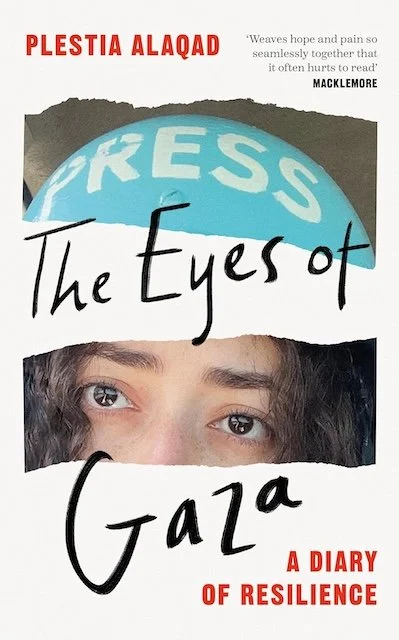
In early October 2023, Plestia Alaqad was a twenty-one-year-old journalism graduate with typical ambitions — a career, a future, a life taking shape. Within weeks, she would be filming the destruction of her home city and sharing it with the world, her posts reaching millions of people who had never heard her name before. By the end of November, she was known simply as the Eyes of Gaza.
The book is written as a diary, which suits the material perfectly. It places you inside the experience rather than at a safe journalistic distance, and what you find there is not only horror — though the horror is unsparing — but also the texture of ordinary life persisting underneath it. Alaqad writes about the people around her with enormous tenderness, capturing small acts of courage and unexpected moments of vulnerability amid the bombardment.
It is worth noting that Israel has banned international journalists from Gaza, which means we are reliant on brave Palestinian journalists to inform us. Many of them have been killed by the IDF - the international federation of journalists estimate that 235 journalists and media workers have been killed since October 23.
Audiobook
I listened to this as an audiobook, and Plestia reads it herself. That gives it a real immediacy — you are not listening to a narrator interpreting events but to the person who lived them. It reinforces the sense that you are inside someone's diary and it is raw and it is intimate, her voice carrying a weight that no actor could replicate. There’s a real poetry to her words.
Genocide
I will be honest: I took breaks with this book. I was listening to a couple of chapters a day, and that felt like the right pace. This is not a book to rush through, and it did affect me.
And then I would catch myself on, as we say here — aware of the privilege of being able to take a break, to close the app, to step away. Plestia could not step away. The people she writes about cannot step away. That discomfort is part of reading this book honestly, and it sits with you.
I feel a deep frustration too — at the useless response of much of the world's powers, at the indifference of governments that could act and choose not to. The questions Alaqad raises are not rhetorical.
What kind of world allows a genocide to take place?
And why do we study history when nobody ever seems to learn from it?
Resilence
This is not just a harrowing account. It is full of resilience, and you get a vivid sense of Palestinian community — of people looking out for one another under impossible circumstances. Plestia is not writing for pity. She wants a homeland. She wants her people to have freedom, to live with dignity in the way the rest of us take for granted.
There are statistics about this genocide, but Alaqad turns figures into faces. She sits in shelters with displaced families, visits children with horrific wounds in hospitals, and refuses to let the numbers remain abstract. She also pushes back against the way Palestinians are so often reduced to victims — these are people with the same hopes and dreams that any of us have.
Homeland
How can the world be so vast, yet when it comes to us Palestinians, there isn’t enough space for us
This is not just a young journalist's account of reporting on the destruction of her own people. It is also a love letter to her homeland. The latter part of the book is also about displacement - Plestia gets an emergency humanitarian visa for herself and her family for Australia.
You can hear the yearning in her voice as she recalls the places and people of her childhood — not just lost as memories, but physically erased, reduced to rubble, wiped from the earth. Her and her family are safe, but she’s watching this from afar.
What stays with you is that this is not, at its heart, a book about war. It is a book about a place — about streets and neighbours and a way of life that was being destroyed even as she wrote. That it refuses to become a lamentation is itself a kind of defiance, and it is what makes it so hard to put down and so hard to forget.
A ceasefire is not an ending
This ceasefire is not an end. It is a pause. Wars do not end when the bombs stop falling — they linger in the minds of those who survive and in the void left by those who do not. For Palestinians, the war is never over. A ceasefire is merely the space between tragedies. And in that space, we are left carrying memories that cannot be undone.
Read this book. Or listen to it. Just don't look away.
Free Palestine.