

Aflame: Learning from Silence by Pico Iyer
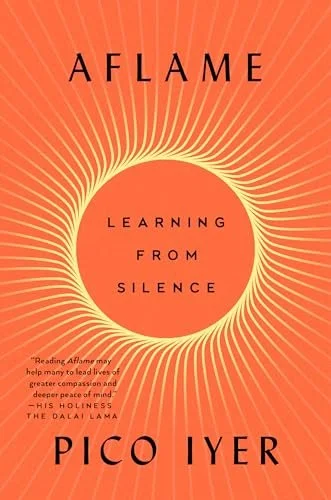
Pico Iyer’s ‘Aflame; Learning from Silence’ is based on three decades of retreats at a Benedictine hermitage high in the hills of Big Sur, California. Weaving personal experience alongside quiet revelations, as well as reflecting on life events such as forest fires, family illness and grappling with grief, this is a meditative book on his long friendship with the Benedictine Community.
Retreat
As has become my habit during the time after the holidays, I made my way to a hermitage in the Glendalough Valley in the Wicklow mountains for a five night stay. I packed a couple of books, Spiritual titles mostly, something to read in the evenings when I’d thrown a few logs into the wood burner. Apart from meditating and hiking, that’s all that was on my itinerary for my post Christmas retreat. It’s a beautiful place to see in the new year.
Apart from the five small, sparse stone cottages, there’s an old coach house where you can find a reception during the day and a few small rooms, one of which contains a library. Though I had enough reading material with me, I like to stick my head in and browse the shelves, just in case I see something that interests me.
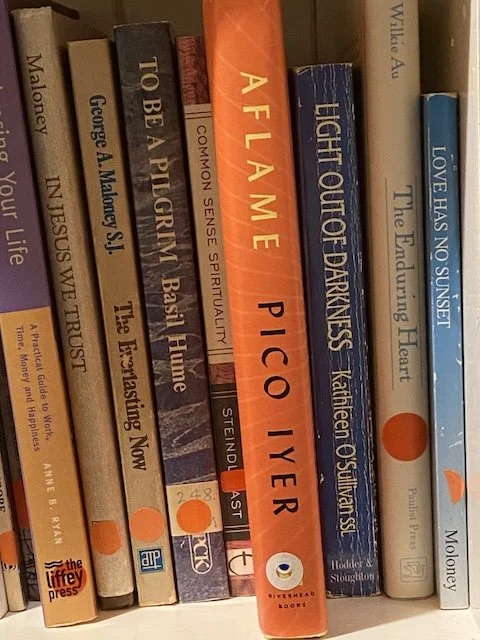
Pico Iyer’s book immediately stood out, not just because I’ve read a couple of his books in the last year (A beginners guide to Japan and The Half known life about finding paradise in a divided world) but also because of it’s bright orange colour, obviously to indicate the title. Hard to miss, so I signed it out for a few days.
Hermitage bookshelf
Pico Iyer
I’d previously listened to his titles as audiobooks, and I’m really glad I got to read this. He’s got a lovely calm, lyrical style, and never overindulges - his reflections are in distilled paragraphs, and it’s like he’s talking quietly slowly beside you.
He comes across as a personable sort, finding it easy to talk to people and get to the spiritual heart of things quickly. He has a knack of finding the light within people, and that’s where the most interesting conversations come in the book. Even when the subjects are heavy, dealing with sorrow or uncertainty, his responses always feel warm and grounded.
I do think I prefer his written word to the spoken, mainly because there were a lot of times I wanted to reflect. Sometimes there were ten minute spells between sentences. That happens a lot with spiritual books, I find.
I liked the grounded, sparse writing style in this. As you’d expect, the tone is meditative, never rushed.
For over 30 years…I’ve never wanted to be part of any group of believers…But what silence ultimately opens for me is not absence but connection.
There’s also lots of literary and spiritual references sprinkled throughout:
Traditionally, the historian R. H. Tawney reminds us, humans were spiritual beings who took care of their material needs for prudence sake. Nowadays, most of us are material beings who, for the sake of prudence, take care of their spiritual needs.
Characters
It’s a book full of interesting characters, little vignettes of those he meets along the way, often imparting some wisdom. Hindu nuns, close friends who are dying, other retreatants and the resident monks - there’s a mixture of folk here.
Lovely to see Leonard Cohen in there, someone Pico gets close to in his later years as a Zen monk, before and after he’d had to come down the mountain and go back on the road again. There’s something poignant about their meetings, Leonard imparting some gnomic insights.
Themes
Fire is a big theme, the constant threat from the surrounding hills. The hermitage is often in danger, and Pico’s mother loses her own home. Obviously this reinforces the idea of impermanence, as nothing lasts forever. But there’s also renewal, in that you have to start afresh, and it clears the ground for new roots to grow.
And obviously it’s about stillness, and what comes forward when we go into that sacred space.
Such a simple revolution: Yesterday I thought myself at the center of the world. Now the world seems to sit at the center of me.
Summary
It feels more like a collection of ideas and notes, sometimes like a diary, rather than a chronological spiritual memoir, but it didn’t spoil my enjoyment of the book. What is time anyway (that’s for another post). I’d say I mostly absorbed this, rather than read it, if you get my meaning.
Pico Iyer was a good companion on those nights between christmas into new years in front of the fire. It’s a cliche, but it’s not just about the journey, but those you meet along the way, and I really enjoyed details of his encounters with people, especially the monks. It was the perfect book in the ideal place for me, quietly profound and never preachy.
240 pages, Paperback
Published August 13, 2025
I no longer include Amazon links in my reviews. Please support your local library and bookshops. Libby is also great.