

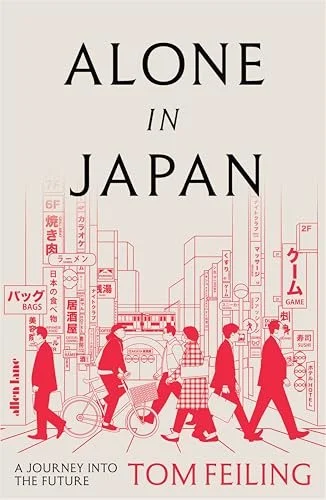
Alone in Japan: A Journey to the Future by Tom Feiling
When I visited Japan last year, one of the things I couldn't help but notice was the number of older people still working. In the konbinis, especially late at night, it wasn't unusual to be served by someone well into their seventies. Older people could also be found in areas of Kyoto directing traffic around the main tourist sites.
It was a personal observation, but it intrigued me. I was fascinated by the culture and history of the country, but I started to become curious about what life was actually like there for people — so I did a bit of research and began to learn more about Japan's losing battle with demographics. When I came across Alone in Japan by Tom Feiling, I was eager to learn more.
Statistics
There are a lot of statistics in this book. But the author also conducts a lot of interviews, and goes on his own journey into Japan's hinterlands to see exactly what is happening on the ground, so it never feels too dry or academic. There were times when the stats piled up, but I generally felt they furnished the main points rather than overwhelmed them.
I'm not going to repeat many of them here, but one stood out above all others: Japan is shrinking. By 2060, the population is expected to have declined by around 40 million — roughly a third of what it is today.
Take Akita prefecture, located in a mountainous region in Honshu, Japan's main island, which has the lowest birth rate and highest death rate in the country. For every child born, three people die — essentially two people disappearing every hour. The population is expected to have fallen by 41% by 2045. Some observers suggest it may have totally died out within a hundred years.
Audiobook
I went for the audiobook version, read by the author. The subject matter can be dry, weighted as it is with statistics, but Feiling does a good job of putting some personality into it. He previously lived in Japan in the nineties, which puts him in a good position to offer opinions on what has changed. His own recollections give the book breathing space from the data.
I'm sure there are books written by Japanese authors that go into even more depth on demographic change, but I was happy to listen to an outsider's perspective — particularly one who had actually lived there. Some subjects benefit from the writer having a degree of distance from the material.
Population Decline
He does a good job on the many factors behind Japan's population decline: the erosion of traditional family structures, rural decline, changing attitudes to having children, the importance of careers for women, and people opting for single lives, among many others. And as for what Japan can do — the country has a famously low immigration rate, but that may continue to change. More emphasis is also being placed on encouraging couples to have children, with increased family allowances and more daycare places. Japan's economy, too, is apparently emerging from a prolonged period of stagnation, which may help.
I found it an endlessly fascinating country even in its difficulties. I particularly enjoyed the tangents — the importance people place on pets (including funeral rites), the rise of robots to combat loneliness and assist with domestic care for the elderly, and the deeply sad stories of people who die alone and villages that are quietly disappearing.
It's obviously about Japan, but population decline is a very real threat facing many western countries too, so the situation there, and how it is handled, is being watched carefully. A canary in the coalmine, so to speak.
Summary
This is very much Feiling's interpretation of demographic change in Japan, and for me it worked best when he brought it down to an individual's perspective. At times it felt doom-laden, and occasionally too heavy on statistics, but I found it a genuinely interesting read. It's not a travel memoir like Chris Broad's sparky, humorous book — it was never meant to be. It's more a social and cultural analysis, which is exactly what I was after.
I've never really seen much of Japan outside the main cities. I hope to visit the rural towns of the country on my next trip — which I'm sure will still be there.
First published February 26, 2026 - 368 pages 12 Hours 58 Minutes
If you do wish to purchase online, feel free to support independent bookshops and contribute to the hosting of this website by purchasing via Bookshop.org. Many of you do, and it contributes to the upkeep of the site and allows me to buy the occasional book.
Please support your local library and bookshops, and Libby is also a great resource.