

The Wind Up Bird Chronicle by Haruki Murakami
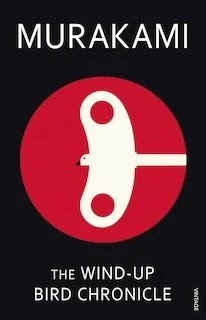
This book was my introduction to Murakami over twenty years ago, and though I remembered the ‘gist’ of the book, I’d forgotten a lot of the details. I’ve read a lot of the Japanese author since then, so before I started my re-read I wondered - isn’t this the one with the cat and the well? And what of this ‘wind up bird’?
I know I must have enjoyed it, as I’ve been a devoted reader of his novels ever since. What was it about the wind up bird chronicle (henceforth known as TWUBC) that got me hooked, and would I enjoy it as much on a second visit?
Story
Here’s a rough outline of TWUBC.
Toru Okada is an unemployed thirty-something drifting through his days in suburban Tokyo when his wife asks him to find their cat — and then, not long after, disappears herself. What starts as a domestic mystery slowly widens into something much stranger.
Toru finds himself pulled toward a dry well in his neighbourhood, drawn into the lives of a series of strangers, and confronted with buried fragments of Japan's wartime past that seem to have no business surfacing in his ordinary life.
That Scene
When I got to the part of the book set in Manchuria, some uneasy feelings started to surface. I knew there was something coming up that had definitely affected me on my first reading.
Murakami has this habit of dropping a visceral, strange, violent scene in his book that you never see coming. I found myself just as affected by this passage as I was first time around, and I took myself off for a good walk afterwards.
There aren’t many authors that have that sort of impact on me, even when I know what’s coming. I must say that I think Lieutenant Mamiya’s scenes were the most vivid and engaging of the book for me.
Toru
I get that some people might see the ‘protagonist’ Toru as quite a frustrating and passive character but I think he’s deliberately written like that. When we meet him he’s unemployed, drifting through his days, waiting for a phone to ring. As things start to escalate around him - Kumiko’s disappearance, strange women and old soldiers appearing to talk to him - he waits, and listens.
He waits at the bottom of the well. He listens to these strange stories from people. It feels like he’s absorbing what’s going on around him, that he retreats into stillness to receive answers. It’s not about what he does, but what surfaces through him.
Kumiko and Noboru Wataya
Kumiko is Toru’s missing wife, who we meet at the beginning of the novel and I’ll tread carefully here so as to avoid spoilers. I would say that before her disappearance that she is the practical one in the marriage compared to the listless Toru, and their life is described as mundane but that’s how they like it.
She has a bigger part more as an absence in the book, and it’s this that pulls Toru to the well in the first place. How much did Toru really know her? Can we truly ever know another person?
Looming over much of the book, mostly from a distance, is Noboru Wataya — Kumiko's brother, and Toru's opposite in almost every way. Where Toru drifts, listens, and waits, Noboru is ambitious, publicly successful, and increasingly visible as a rising political figure — smooth, media-savvy, and persuasive to everyone but Toru.
He's rarely on the page directly, and yet his presence shapes the novel's undercurrent of dread; there's a sense throughout that he represents something Toru has to reckon with, even if it's never entirely clear what that confrontation will look like or what it means.
What makes Noboru so effective as a foil is that he's never a cartoon villain — Murakami gives him charisma and public credibility, which makes Toru's private unease about him feel harder to justify. Their opposition runs through the book, surfacing fully only when it has to.
Unconscious
One of the aspects of Murakami's work that makes him stand out so much for me is the unconscious - the darker parts of us that we’d rather not visit. The unconscious here isn’t as much a theme, as a place where most of the novel is set in. For a start, Toru makes the decision to spend time at the bottom of a well - in terms of the journey inwards, it doesn’t get much more obvious than that. Dreams and the waking life bleed into each other; Toru's encounter with the woman in the hotel room feel real.
There’s also intergenerational trauma, a national conscciousness arising from Japan’s involvement in WW2, found here in the Manchuria scenes with Lieutenant Mamiya. What society tries to bury comes back through people who weren’t even there.
The unconscious in Murakami's world is shared space that character can navigate, where identity, history, violence, all blend into each other. It’s hard to think of an author who does it so well.
I also have to mention the mark on Toru’s face. Not long after one of his stretches at the bottom of the well, a strange mark appears on Toru's cheek — a bruise-like discolouration that no doctor can explain and that simply wasn't there before. It's never treated as an injury in any ordinary sense. It reads instead as a kind of residue, as though whatever happened to him in the dark left a trace that surfaced on the outside.
What I find so compelling about the mark is how it collapses the very boundary the rest of the novel keeps testing — between what happens inwardly, in dream and descent, and what's visible to everyone else. Other characters notice it, and something in how they respond suggests they sense a shift in him beyond the physical.
It also seems to coincide with moments later in the book where Toru acts with a decisiveness, even a capacity for violence, that feels entirely unlike the passive, waiting man we met at the start — as if the well didn't just change what he understood, but what he was capable of. Murakami never explains the mark outright, and I don't think he needs to; it's proof enough that whatever Toru goes down to find, he doesn't come back from it unchanged.
Non-Duality and Shadow Work
So often my interpretation of events in this book coincided with my interest in shadow work and non-duality. Reading this now, years into my own sitting practice and no small amount of shadow work, I found myself seeing Toru's stillness differently than I did twenty years ago.
Back then it just read as passivity — a man waiting for life to happen to him. This time it looked more like practice. He doesn't go down into that well to escape or to fix anything; he goes to be with what's there, without pushing it away or needing an answer straight off. That's close to what non-duality teachers mean by allowing — staying present with the uncomfortable material rather than bypassing it.
So - what is a wind up bird?
“nearly all within range of the wind-up bird’s cry were ruined, lost.”
The wind-up bird is a recurring, unseen bird whose creaking cry — like a spring being wound — echoes through the neighbourhood at key moments, usually right before something significant is about to shift in Toru's life or the wider story, like an omen I suppose.
I don’t really have an answer, just more questions. Does it mean a pattern from the past is being repeated? Are we witnessing fate in action? Is it when the conscious/unconscious worlds are overlapping? This being Murakami, it’s never fully explained, nor should it be. It's evocative and eerie rather than symbolically tidy.
First time reader
I love the succinctness of Murakami's writing, how he layers his ideas. Even though his books are translated from Japanese, there’s a wonderful clarity to his imagery and storytelling.
What I would say is that this is a long book - 600 pages. And compared to some of his other books, it’s more ambiguous, and if you’re not used to Murakami, it might seem impenetrable and just…..strange.
But this is where I started over twenty years ago, and I immediately fell for his storytelling. It might not be for you - Kafka on the shore is another good option (I’m currently compiling a list post on Murakami’s books)
Summary
There's so much to admire about this book, and with that much depth, of course I lapped it up a second time around. I took far more time with it on my second reading, appreciating how carefully Murakami layers things. And he's just so damned readable, for a book that asks this much patience.
I've gone on at length about my own reading of it — shadow work, non-duality, the way the conscious world seeps into the unconscious. I don't pretend to understand all of this book, even after two readings twenty years apart, and that's true of all Murakami's work for me — there's an undefinable, wondrous quality you just feel rather than explain.
Like I’ve said, if you're new to Murakami, though, I probably wouldn’t start here. Save TWUBC for once you've read a book or two of his and already trust where he's taking you — the patience it asks for pays off far more once you know that's simply how he works. Kafka on the Shore or Norwegian Wood is where I'd point a first-timer; this is the one you come back to once you're already hooked.
First published January 1, 1997 by Knopf - Translated to English by Jay Rubin
607 pages
If you do wish to purchase online, feel free to support independent bookshops and contribute to the hosting of this website by purchasing via Bookshop.org. Many of you do, and it contributes to the upkeep of the site and allows me to buy the occasional book.
Please support your local library and bookshops, and Libby is also a great resource.