

Becoming Yourself - Teachings on the Zen Way of Life by Shunryū Suzuki
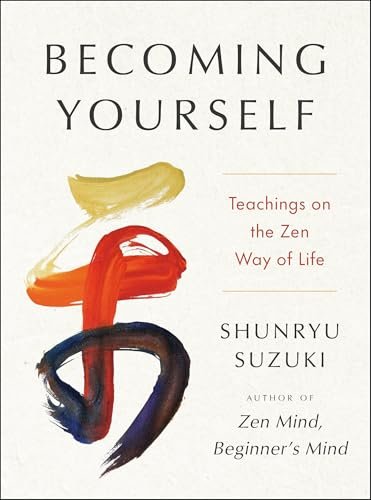
Shunryu Suzuki Roshi arrived in San Francisco in 1959, a quiet Japanese Zen priest who ended up changing the spiritual landscape of the Western world. His new book — the first collection of his talks in over two decades — is called ‘Becoming Yourself,’ and it carries the same unhurried clarity that made ‘Zen Mind, Beginner's Mind’ a classic.
The point is to learn how to be yourself, how to be a person in the way that a stone is completely a stone.
Shunryū Suzuki
This is the second mention of Shunryū Suzuki in this blog. A few years ago I wrote a post about on my favourite books on Meditation and Mindfulness and ‘Zen Mind, Beginners Mind’ got a mention. There was something in the stripped back, simple style that for me made it such a wonderful introduction to Zen Buddhism.
Like that book, ‘Becoming Yourself’ is based on talks given by the famous Japanese Zen priest. As mentioned above, he is credited as being one of the most important figures in bringing Zen Buddhism to the West, and ‘Zen Mind..’ is considered a classic of it’s kind.
This first collection in over two decades was put together by Abbot Jiryu Rutschman-Byler and the late Sojun Mel Weitsman, who spent years working through recordings and rough transcripts.
‘Nothing outside yourself can cause any trouble. You yourself make the waves in your mind. If you leave your mind as it is, it will become calm.’
Three Movements
‘Becoming Yourself’ is divided into three parts - The first is on sitting and being yourself, the second on bringing that spirit into your daily life, whilst the third is centered on the Buddhist precepts - guidelines for living with integrity.
I liked how this was structured - each part fed into the next one. Practice is nothing if you can’t bring it into your daily living. What’s the point otherwise? I found the last section on ethics interesting, and something I’d like to read more on, whilst the first two ‘movements’ will be revisted quite a few times.
Teacher
He was obviously an extraordinary teacher, and I honestly feel that his quiet wisdom really comes across in these pages. What he’s saying, what comes from Zen Buddhism, is ultimately is that there is another way to be. Not to stop and think, or stop and figure yourself out, but just to stop. To sit.
What surprised me reading this was how radical that actually feels — how much resistance arises, how much the mind wants to turn even stillness into a project. But underneath all that, Suzuki seems to be pointing at something that was never missing. The sitting isn't a technique for getting somewhere; it's more like coming home to a place you never really left.
It just happened that during my time of sitting with this book that I was also ‘practising’ natural meditation, or do nothing meditation as it’s sometimes called. It’s been interesting for me to notice how much grasping the mind engages in, looking for a technique in something as simple as meditation. To just sit, with no method, has been so liberating.
"Leave your front door and your back door open. Allow your thoughts to come and go. Just don't serve them tea."
Summary
Whether you’re just exploring Zen Buddhism or a seasoned practitioner, I think you’ll find something that resonates in this volume. I’m not sure it has the immediacy of ‘Zen Mind, Beginners Mind’ but not many books do. It’s a quiet, generous book, that yo read slowly and return to. (I returned to the first page when I reached the end.)
For a teacher who died in 1971, he feels remarkably present on every page.
The best pointings are simple, true and straight:
Stop trying to get somewhere and notice what’s already here.