

I Deliver Parcels in Beijing by Hu Anyan
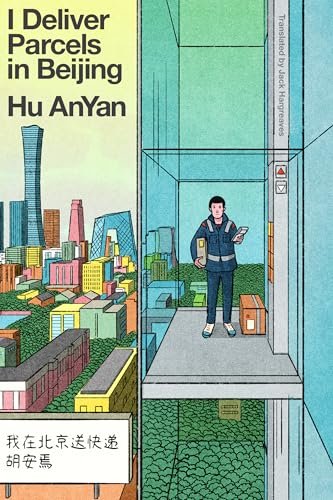
In 2023, a Chinese man called Hu Anyan posted an essay online about working the night shift in a sweltering logistics warehouse — and it went viral across a country of a billion and a half people. He had worked nineteen jobs in roughly as many years, drifting between cities with little more than his copies of Chekhov and Carver for company.
Literary Sensation
What began as an essay has become a literary sensation in China, and when translated worldwide it made many ‘best of’ lists at the end of 2025. So what is it about a man describing 19 jobs in 19 years that has made this such a success?
Hu Anyan was born in Guangzhou in 1979, and as a young worker in a burgeoning economy he found himself working in a variety of positions across the country. During the covid lockdowns he began posting online of his experiences in a logistics warehouse where the nights were so hot, he could drink three litres of water - without being able to take a toilet break.
These online posts became popular, and though he had no intention of writing a book, in the short amount of time he had available he began to do so.
Beijing
One of the main sections of the book is Hu’s job delivering parcels in Beijing. He arrived there one morning in Spring 2018, uploaded his CV to a job site, and had a phone call before lunch. He was recruited through a headhunting service and went for an interview that same afternoon in Yizhuang. It begins almost comically fast —one day in Beijing, already working.
The conditions were relentless: twelve-hour shifts, unpaid trial periods, extreme heat, constant surveillance, and the economic pressure to complete a delivery every four minutes to remain profitable.
Riding an electric trike in summer, the metal was often scalding to the touch within moments of parking. He describes waiting over half an hour outside residential complexes for customers who kept saying "soon, soon" — then calling back an hour later to ask where he was.
Under constant pressure, it takes its toll and eventually the job comes to an end. Knowing this seems to give him renewed energy - there’s kindness and humanity in the way he no longer rushes his route, taking the time to talk to customers, going out of his way to help them when delivering.
Other Jobs
Selling bicycles, running a women's clothing store, working in a bakery, making 3D architectural renderings, doing night shifts at a logistics warehouse - there’s not much he doesn’t do, with a variety of bosses along the way.
What’s striking is that there’s no upward trajectory to these positions - he’s mostly moving between horizontal rungs, the workload and pay staying the same. Convenience store clerk, security guard, he just moves between them with little complaint.
China
Hu has called himself an ‘honest recorder’ rather than a critic of low paid labour. He is just one of the millions who has left rural China for the cities, many of whom are undocumented with no access to social services, subsidised housing, public schools or healthcare. I found it interesting to read about ‘the hukou system’ — which ties social entitlements to your place of birth registration — and means you can live and work in Beijing for years while remaining effectively invisible to the state.
China inhabits late-stage capitalism through its unique blend of market economy and state-owned business — there is no Amazon but instead the vast Alibaba ecosystem, WeChat instead of Facebook. The logistics network is incredibly efficient, with next day delivery within the same province — but this progress, as Hu says himself, comes at the expense of workers at the lower end of the industry.
You can understand why the book has resonated in his homeland.
Hu Anyan
I found myself admiring Hu Anyan because he doesn’t constantly complain about these jobs. There’s something very zen about the way he goes about his work. He doesn’t seem to have much in the way of need -it’s not that he’s supressed them, it’s just he had reduced them so he doesn’t need a lot to get by.
There’s no cynicism or bitterness in his writing - in fact, he comes across as humble. As a writer he’s blessed with a keen, sharp eye, and is an unflinching observer of the world he’s in.
But of course it does affect him. One bit that stood out for me was when he talked about how the delivery work was eroding him - he writes that there is a reason deep-sea fish are blind and animals in the desert tolerant of thirst — a big part of who he is is determined by his environment and not his nature.
There’s no drama or pity to his observations, and it often felt like an act of contemplation.
Audiobook
This is one of those occasions when I’m not going to recommend listening to the audiobook. It took me an absolute age to listen to this because I kept drifting off and constantly found myself having to rewind because I’d missed whole chapters. If you’re having sleep issues, like I am, perhaps it’s the book for you, but I wanted to pay attention to the book and found I couldn’t.
At times it’s just hypnotically boring - apt given the work being described. Winson Ting does an admirable job, but I found myself fighting a losing battle if I listened to this when I was tired.
Summary
What was most interesting to me was Hu’s role as observer. Even though he’s performing these roles whilst being trapped in an algorithm that governs his deliveries, the unpaid trial shifts, the wages that evaporate - he's simply watching. Watching the system, watching his colleagues, watching what the work does to him, watching himself react.
He finds freedom in his ability to remain aware of himself within his circumstances rather than being entirely consumed by them. He is present as the awareness watching it all. Non dual, I know.
Deliver Parcels in Beijing is not really a memoir, and it's not really social commentary either — though it contains both. It ends up being an act of sustained, honest attention to ordinary life, written by a man who had nothing to prove and no agenda beyond telling the truth of what he saw.
He wrote it all down without bitterness, without self-pity, and with a dry humour that keeps the darkness from becoming unbearable. Reading it, I kept thinking about presence — about what it means to remain yourself inside conditions designed to erase you. Hu never frames it in those terms. But the question is there on every page, quiet and insistent, whether he intended it or not.
Penguin Audio 2025
Translated by Jack Hargreaves
Read by Winson Ting - 10hrs 19 mins