

Few and Far Between by Jan Carson
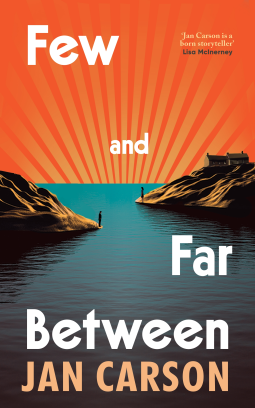
In 1958, a Stormont politician proposed draining Lough Neagh — the largest lake in Ireland — to create a seventh county for Northern Ireland. It never happened, but in ‘Few and Far Between’ Jan Carson has looked at that forgotten piece of political madness and asked: but what if it had?
Terence O’Neill
As barmy as this sounds, it was said to have been an idea conceived by Terence O’Neill, who became prime minister of the North in 1963. The idea was to drain the Lough, turning the area into a seventh county of Ulster, boosting employment in the area. Ultimately and not surprisingly, the idea came to nothing.
But maybe it’s not as far fetched as it sounds. When you consider the ingenuity of the Dutch with dykes and polders, land reclamation projects from the Chinese, Ancient Egyptians and Aztecs, perhaps he was onto something. A quick google even reveals that draining Lough Neagh was tried four times between 1846 and 1959 to prevent flooding - which sometimes revealed small submerged islands.
Lough Neagh
I’ll come back to those small submerged islands shortly. But first Lough Neagh - never out of the news here in the North of Ireland. 5 miles wide and 18 miles long, it’s been supplying over 40% of the North’s drinking water and supporting Europe's largest commercial eel fishery. Part of its shoreline lies in County Armagh, just a few miles up the road from where I am. It’s been central to life for generations of families here.
In the summer of 2023, massive blooms of blue-green algae appeared, so severe they were visible from space. Despite a national outcry, the algae returned in 2024, then again in 2025, and is now back once more in 2026. It’s an incredibly depressing story, but what caused it?
Well, it seems to be a combination of factors. For decades, excess nutrients from agricultural fertiliser, poor wastewater treatment and septic tanks have polluted the water. Climate change and the presence of an invasive species, the zebra mussel, have encouraged the growth of the poisonous blue-green algae.
To further complicate matters, the bed and soil of Lough Neagh is privately owned by the Earl of Shaftesbury, an English Aristocrat which has made more difficult efforts to establish community ownership and proper governance. Enviroment minister Andrew Muir has tried but repeatedly comes up against vested interests.
Like I said, never out of the news and the headline is a simple one: The Lough is dying.
Islands
So back to those Islands I mentioned earlier. What Jan Carson has done is imagine what would have happened if O’Neill’s plan had come to fruition - and what would life have been like on the islands for those inhabitants?
Well, this is a Jan Carson novel, and if you've been here before, you'll know I rate her highly. Books such as ‘The Raptures’ about a mysterious illness which affects a group of school children. And the dark and quirky short story collection ‘Quickly, while they still have horses’.
So life on the islands as imagined by Carson is done in her own distinctive style, and is centered around Marion and Robert John, siblings who grew up on the Ark - the name given to the collection of small islands on the ‘Archipelago’.
The Ark
Marion and Robert John were the children of renowned anthropologist RJ Connolly and Ursula, who moved the family to the Ark in the 60s. The group of islands was viewed as a sanctuary from the troubles which were to break out at the end of that decade.
The people who moved to the islands were generally those whom mainland society judged and condemned. On the Ark, they were accepted. Fuelled by heady optimism, the people who settled on Big Flat were not just getting along — they were actively integrating, mixing and mingling, cohabiting without a thought for the traditional sectarian divide devastating the North. As RJ mentions early on, the Ark is "both victim of the ongoing conflict and an act of embodied protest" against it. But the novel makes clear the utopia was never as clean as the idea of it.
In the modern day, the authorities have decided that the Lough should be flooded, hopefully dealing with the algae problem. The Connolly children are terrified of this taking place, as it would mean they were being flooded out of their home, and forced to face truths they’d prefer not to confront.
Marion and Robert John
Marion and Robert John are the main characters in the book. A lot of Robert John’s story revolves around his relationship with his father, and how that has shaped him as a man. I’ve read some excellent books on toxic masculinity, such as Michael Magee’s ‘Close to Home’ but this is interesting in that Robert John is a lot older (late fifties/early sixties).
Marion has been a caretaker to this island, and there is a feeling that life is passing her by. She has a secret addiction to social media, and wonders what her role, if any, would be in the outside world.
The Ark is their prison as much as their home. They can't leave because of what they'd have to face, and they can't stay because the flood is coming whether they like it or not.
There are other characters. Alex is a young anthropologist who arrives on the island, keen to meet the offspring of the esteemed RJ Connolly, who the siblings hope can help them stop the flooding, whilst they are also wary of in case she discovers some secrets about the past.
There are few residents left now, but there is Sandra, an older Trans woman who doesn’t think she can face life on the mainland. There other inhabitants of the island, who aren’t as easily explained.
The Stranger Islands
There's always a point in a Jan Carson book when I'm reminded why I enjoy her work so much, and it's when the magic realism first reveals itself. It works so well because it gets at something straight realism can't — that the trauma of the conflict didn't end when the conflict did. It seeped into everything: families, mental health, how men behave, how women are treated. Carson doesn't lecture you about any of this. She just builds you an island and lets you figure it out.
This is where the magic realism takes hold - the ark is grounded enough to seem real, but also very strange. There’s the sleepers - women who won’t wake up and are nursed around the clock. The almost deads, souls in limbo, clinging on. (These folk made me think of ‘Lincoln in the Bardo’ by George Saunders). There's also one for suicides, and another that swallows anything placed on its surface.. Handy in the North for those who wanted to get rid of a range of incriminating materials, but these things have a habit of reappearing.
Summary
This review took a lot longer than expected as I got drawn into quite a few internet rabbit holes as I read about the history of the Lough. It also got me thinking a lot about the themes in the book and what Jan Carson has to say about the North, about trauma, about memory, and the things we as a society here would prefer not to face.
Maybe I’m being too simple in my understanding (but hey, it’s my blog so I can interpret it any which way I want) but the novel is not just the inability to confront the past — it's that the past won't let you go either. The ark is that place where we thought we could quarantine our trauma, only to discover that water always finds a way back in.
Like I said earlier, the Lough is dying. Years of mismanagement, of agricultural runoff that nobody dealt with - burying the problems rather than dealing with them - has resulted in this.
Really enjoyed the book, (I should say it’s very funny in parts too) and the Lough Neagh crisis gives the novel an almost unbearable real-world weight. You can probably tell by now that she’s one of my favourite storytellers.
Few and Far Between is about what happens when a society tries to solve its problems by putting them on an island and hoping they stay there. They don't. They never do.
Pub Date Apr 09 2026 | Random House UK, Transworld Publishers
Thanks to Random House UK for the ARC via Netgalley
Available via Bookshop.org and there’s a special edition via No Alibis bookshop