

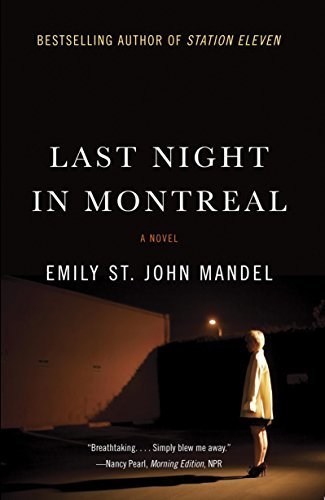
There aren’t many authors I could read three books by in a row. I’ve just finished The Singer’s Gun, I’m now reading Exit Party, and in between came Last Night in Montreal, Emily St. John Mandel’s first novel. There’s something intriguing, original and beguiling about her writing that keeps pulling me back.
The Story
We meet Lilia at the beginning of the book in Brooklyn with Eli, before she disappears after heading to the store. Eli follows her to Montreal after receiving a mysterious letter - but he isn’t the only one on her trail. A private investigator named Christopher has been following her for a long time, and his own relationship with his daughter, Michaela, is under strain.
The story moves between two timelines: Eli’s search for Lilia in Montreal, and Christopher’s pursuit of Lilia and her father across the States. It’s the dovetailing of these two stories that leads to the climax of the book.
Lilia and Themes
One of the recurring themes in Mandel’s books is running away and trying to escape. Lilia can’t settle anywhere after being “taken” by her dad when she was young. Her life is one of constant flux, and it affects her relationships too. It also begs the question - Can you ever really, truly know someone else?
She is unable to stay in one place, and as soon as she begins to feel comfortable, panic sets in and she has to flee. Because of her upbringing, she associates movement with safety, and stillness with danger.
Another of the themes that runs throughout Mandels books is that of identity, and how it shifts. Because she has no memory of her life before the age of seven, she doesn’t have a fixed identity, and even keeps a list of the various names she has had. But she does want to be witnessed, and leaves a trail of breadcrumbs in the Gideons bibles she finds in motels.
She and Eli both share a love of languages, again related to identity - Eli is an academic who studies langauges that are dying. What does a culture lose when a language dies? Montreal functions as a dual language city, and Eli experiences what it’s like to be an outsider here when you don’t speak French. It reinforces his sense of isolation.
It’s also a book about looking or things - lost people, lost memories, lost languages.
Mandel’s Writing
I really enjoy her writing style. It’s unusual, and I’m never sure what direction she’s going in. It isn’t a world I trust, and I mean that in the best way. There’s a haunting, etheral quality to her prose, and she describes her characters with such empathy and without judegement.
It’s a dark story, especially in the cold, seedy corners of Montreal, and I found the ending particularly troubling. But there’s also something melancholic in Mandel’s worlds. Her storytelling is enigmatic, the settings are atmospheric and the pace is slow. It’s so clear, and it casts a spell over me.
Questions I’m Still Asking
I had a few questions that I suppose will go forever unanswered, mostly around Christopher’s “relationship” with Lilia and how it affected his daughter, Michaela. I’d love to talk to someone who has read this book and could shed some light on Michaela’s actions. I think Christopher saw something in the relationship between John and Lilia that made him wish he’d been brave enough to do something similar with Michaela.
It took me a few hours to accept the open ended nature of the ending, the unanswered questions. Truama doesn’t have a neat, tidy resolution. It remains - you have to learn how to live with it.
If you’ve read it, comment below if you can shed any light!
Final Thoughts
It’s too simple to just say I enjoyed the book and give it a mark out of ten- parts of it haunted me, and although I was at first frustrated with the ending, I’ve reconciled with that now. The plot will fade, but you’re left with the same sort of feeling you have when you wake from a vivid dream but can’t remember the details.
First published June 3, 2009
230 pages