

The Singers Gun by Emily St John Mandel
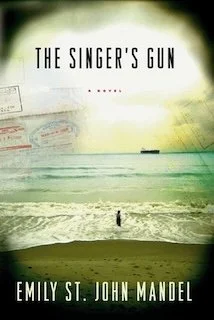
The Singer’s Gun by Emily St. John Mandel — Review
When I found out Emily St. John Mandel had a new novel out, I got excited — and then a review of Exit Party mentioned that one of its characters, Ari, first appeared in The Singer’s Gun. Well, I just had to go back and read it then, didn’t I? Not a hardship when it comes to Mandel.
I trust her. There’s an unspoken contract between reader and writer, and with her I’m happy to let a scene sit unexplained, because I know it’ll mean something later. She’s one of my favourite writers, and that trust has been earned over four novels. Station Eleven was the first of hers I read, and I’ve followed her since.
What It’s About?
Anton Waker has spent years building an honest life, away from the forged passports he once sold with his cousin Aria. Then a routine security check at work starts to pull it all apart — will one final job be enough for him to start anew?
It has elements of a crime novel, and early on we meet Detective Broden, who is on the trail of Anton and Aria. Mixed up in this is Elena, Anton’s secretary and one of the beneficiaries of their business.
The first few pages suggest an ending that the book builds slowly towards, and there’s a case that develops and keeps you guessing. But because it’s Mandel, the plot didn’t go the way I thought it might. The ground under your feet is always somewhat unsteady in a Mandel novel.
The Writing
Her writing is stripped of fat, trimmed down to only what matters. Fluid, shiny prose. It’s poised, and the pacing is gradual but never stilted. There’s always something moving in each scene, even if you’re not sure what it is. Like I mentioned earlier, it will reveal itself.
There’s also something theatrical about this book in terms of its settings. It feels like there are three or four “stages” that she is able to flesh out and colour in, in the reader’s mind, each time we visit.
The scenes are so precise — whether they are Russian cafés, Manhattan offices or Italian seaside towns — that as a reader you feel like you enter them from the first few words of the description. There are enough details, but there is a stillness at the heart of them. Conversations are sparse and to the point, but revealing.
‘He was unprepared for the sound. The city was all around him, and he was lost in the noise. There were trucks, horns, sirens from Lexington Avenue and from the cross streets, but behind these individual noises was the sound he stopped to listen to sometimes when he was jogging alone in Central Park at night. A sound formed of traffic and helicopters and distant airplanes, voices, car horns, conversations and music, sirens and shouting and the underground passage of trains, all combined into a susurration as constant and as endless as the sound of ocean waves.’
The Characters
For me, though, it’s about the interactions between the characters — that fluidity. And there is, of course, something running deeper in her books, something harder to describe. But I’ll try.
She makes her characters interesting. They have dilemmas that reveal who they are.. There never seems to be any judgement of the family business on Anton’s part, but he has decided it’s not for him. Does it define him? How much of it sits at the heart of his relationship with his parents?
The plot kept me intrigued, but as with Mandel’s other books, I was more taken by the musings of characters like Elena and Anton.
Anton is an interesting one. How much of his character is set? Can we rebuild ourselves? Can he live in a construct of his own making, invent a past?
Aria is perhaps more unwavering, fatalistic. I always felt that she enjoyed flirting with danger, that she knew everything around her was built like castles in the sand. Her lightly sketched background suggests she knew her world could be upturned at any moment, and she built her life around this.
Elena falls somewhere between the two. She is lost, afraid of being sent back to a place where she no longer belongs, and although she wants to be in New York, she is floundering for a path.
Final Thoughts
Is it my favourite Mandel novel? Not quite. The stakes feel smaller, and it isn’t as wide in scope as her later books — in fairness, one is about a plague and another features people living on the moon. But reading it now, after Station Eleven The Glass hotel and Sea of Tranquility, it’s like finding an early sketch of a painting you love. The questions she keeps coming back to are all here: who we are, whether we can start again, how much of the past we carry.
If you’ve just finished Exit Party and want to know where Aria came from, start here. If you’re new to Mandel, begin with Station Eleven and work your way back.
287 Pages
First Published May 1, 2010 by Unbridled Books