

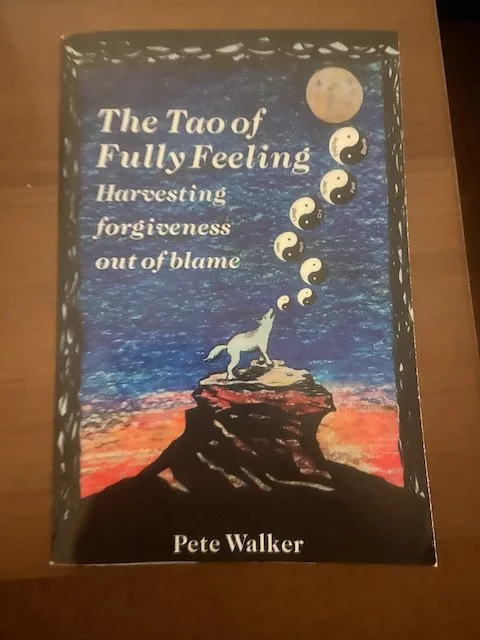
The Tao of Fully Feeling: Harvesting Forgiveness Out of Blame by Pete Walker
Pete Walker
I can’t remember exactly when I purchased this book, but its been on my shelf for a while now, perhaps a couple of years. I know I’ve been interested in shadow work, dealing with emotions that come up during meditation so I must have seen it recommended somewhere and sought it out.
Pete Walker is a California psychotherapist who specialises in childhood trauma, and is perhaps best known for his book Complex PTSD: From Surviving to Thriving, which popularised the idea of emotional flashbacks and expanded the classic fight/flight/freeze responses to include fawn: people-pleasing as a survival strategy. He writes as a therapist, but also as someone who came out of a violent, neglectful childhood himself.
Grieving and Angering
The Tao of Fully Feeling: Harvesting Forgiveness out of Blame (1995) is his earlier book, and its central premise is that healing isn’t about simply forgiving, or thinking your way out of trauma, but about grieving: actually letting yourself feel what was suppressed. He breaks that grieving down into crying, “angering” (healthy anger at what was done to you, released safely rather than aimed at anyone), verbal ventilation, and simply feeling.
He also talks about how important it is not to forgive too early. Real forgiveness is something you harvest after the blame and grief have been fully felt, not something you force. The Taoist framing is about accepting the whole range of emotion as natural, like weather or seasons, rather than labelling some feelings good and others bad.
Exercises
What I liked about this book is that Walker offers practical tips to help you enhance feeling. Simply described, it’s about putting your feelings into sensations and letting your awareness rest there. Focusing here, you may find that more painful memories arise, and it’s these that you stay with. It sounds easy, but it takes work.
Other exercises include those centered around angering, which is about releasing anger without directing it at anyone. Writing a letter to someone who has hurt is another one, a sort of verbal ventilation. One that I found particularly useful was about blame and forgiveness, simply using your imagination to reimagine a situation. There’s no doubting that it did stir things in me, but that’s where the work is.
Shadow Work
As I said previously, my interest coming into this book was via shadow work. My own understanding of that would be turning towards the feelings and parts of ourselves we learned to hide. From a non-dual point of view, it isn’t about fixing ourselves, but about no longer fighting what arises, and letting even the hardest feelings be fully met.
Walker never uses that phrase, but his grieving is about feelings and loss. It’s letting out the sadness and anger about what happened to you, which were never safe to express at the time. The method is expression: crying, angering, putting it into words.
Blame
I found his thoughts on blame particularly enlightening, and it’s why the subtitle of the book is so important. It’s about putting blame back where it belongs, not holding it as a grudge. It made sense when he said that forgiveness can’t be forced; the anger and the grief have to be worked through. I’d never thought about it like that before.
I think growing up with a religious upbringing, forgiveness feels like a duty. It’s not something you question, but it really made me think about how easy it is to leave the hurt and the self-blame buried.
Spiritual bypassing is something I’ve been thinking about recently. With non-duality and spiritual awakening, there can be a tendency to just repeat “I don’t exist’ or “I am just awareness’, and ignoring those feelings that come up. I can see how it can happen, and I’ve been trying to avoid it.
Summary
It took me a number of months to get through this book. I wouldn’t describe it as heavy, and he writes in a warm and easy manner and doesn’t rely too much on therapy speak. Rather, much of what he said brought up a lot of ‘stuff’ and the associated emotions as I worked with some of his suggestions. Some of his other examples didn’t apply to me, but I found them interesting nonetheless.
This is a really valuable, worthwhile book, and one that I’d happily recommend to anyone interested in shadow work or working with heavy feelings being stirred by deep meditation.
Pete Walker also has a website where you can read many of his articles for free.
Blame
I found his thoughts on blame particularly enlightening, and it’s why the subtitle to the book is so important. It’s about putting blame back where it belongs, not holding it as a grudge. It made sense when he said that forgiveness can’t be forced - the anger and the grief have to be worked through. I’d never thought about it like that before.
I think growing up with a religious upbringing, forgivness feels like a duty. It’s not something you question, but it really made me think about how easy it is to leave the hurt and the self-blame buried.