

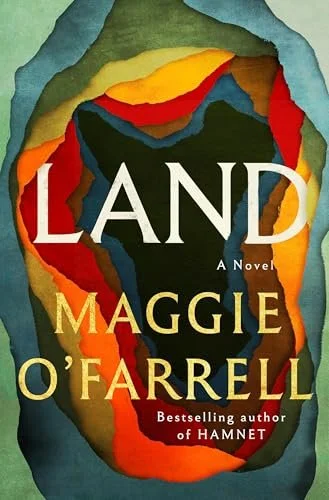
Land by Maggie O’Farrell
What Is Land About?
Land takes Maggie O'Farrell back to Ireland, and to her own family. Born in Coleraine, she has based the novel on her great-great-grandfather, who worked for the Ordnance Survey in the years after the famine.
The book opens with a father and son mapping a peninsula in post-famine Ireland in 1865. The peninsula is imaginary, somewhere on the west coast (it felt like Kerry or Clare to me). A lot of the book feels like O'Farrell exploring what life must have been like for her ancestors, and recreating that.
This is a story that spans two generations. It starts off with Tomás and his ten-year-old son, Liam, before we meet an older Liam sometime in the future.
The Famine Years
Some of the most powerful passages for me came early on: Tomás's glimpses back into the famine years, the bodies in ditches, burying relatives. Wrenching scenes as he is transported to the workhouse, and memories that surface later of the conditions there and the coffin ships. A widow recounting the empty cottages, the families decimated. It's a visceral and vital remembering of the past from O'Farrell.
Between 1845 and 1852, more than a million people died of starvation or famine-related disease, and a further million were forced to emigrate, many of whom expired at sea. Tomás lived through it, and that weighs on him; I thought that his survivor's guilt runs right through the book. In fact, I’d say the episode at the tobar triggered something like PTSD.
I think O’Farrell does an excellent job of getting across the devastation of the famine of individuals, on families and their descendants. There’s a really moving section where a widow talks about each house on the peninsula, and the familes that lived there, each one lying empty.
It got me thinking about other books on the famine. Joseph O’Connor’s excellent Star of the sea was one. The Silent people by Walter Macken is another. I’m sure there’s a lot more.
Mapping What Was Lost
Tomás is in the employ of the English soldiers, the redcoats, and he is determined to include the empty houses and famine graveyards, the local landmarks, lest they be forgotten, literally written out of topographical history.
Then the mapping splits in two. Tomás begins a second set of maps using the original Irish place names, while Liam quietly finishes the anglicised versions and hands them over to the redcoats. Irish readers will think of Brian Friel's Translations, set in a Donegal hedge school in 1833 as the same Ordnance Survey renames the places around it. Both are about what's lost when a place loses its name, and in a country the famine had already emptied of its people, a map becomes a kind of memorial.
(One of my favourite books on Irish place names is Manchán Magan’s ‘Thirty two words for field’.)
We still have redcoats in Ireland: it's how we refer to the traffic wardens pestering motorists around the town where I live. They don't generate quite the same fear or animosity, though it's funny how phrases reverberate through the ages.
The Tobar: A Sacred Well at the Heart of the Book
It's on the peninsula that Tomás stumbles across a place, just after Liam makes a quick escape from it: a small copse centred around a pool of water. It's a mystical place that crops up at a number of key moments, and allows O'Farrell to bring an element of Celtic mysticism into the book.
Holy wells like this were sacred springs long before they were 'claimed' by the church. The hill I live on, Ard Mhacha, was a sacred site too, before it was claimed in the same way.
Myth and the Mythic
Mythology plays an important part throughout. The family dog is named Bran, after Fionn mac Cumhaill's own legendary hound. There's also something mythic about the non-verbal son, Eugene, who is connected to the land in a way that's deep and grounded.
Irish myth is full of sacred wells, and the most famous is Tobar Segais, the Well of Wisdom at the source of the Boyne. There the Salmon of Knowledge ate hazelnuts from nine sacred trees and absorbed all the wisdom in the world, until a young Fionn mac Cumhaill burned his thumb cooking it, sucked the burn, and took that wisdom for himself. It's a story about knowledge coming not from striving but from connection with the land itself, which is very much where Land lives.
The History of the Land
One of my favourite sections is an incredible passage in Part Two, where O'Farrell lays out the history of that same piece of land (the copse with the pool and the prayer altar we met in Part One) from pre-Christian times right up to when Tomás and Liam discovered it.
It begins with a family who lived in a nearby fort: a young girl and her wolfhound, with what felt like a nod to the Salmon of Knowledge. Druids, standing stones and sacred altars. Then right through the conflicts: the arrival of monks, Vikings, colonialists from England.
It's such a startling piece of writing: the history of the place intertwined with the land, even hearing from the bodies beneath the soil, full of wonderful imagery that just flows off the page. O'Farrell at her best. The land becomes a living, breathing character, and it reminded me of Daniel Mason's North Woods, which does something similar with a patch of New England woodland.
Characters
I’ve already mentioned Tomás and his son Liam, but there are other characters here, who we return to throughout the book. Phina is the hardworking wife and mother, who holds the family together when Tomás falls apart. She is the pragmatic foil to Tomás’s obsessive mystical pursuits.
The eldest girl is Enda, who is clever, strong and restless. Rose is more stoic and grounded than her sister. Eugene, who, as I’ve already mentioned, is non-verbal, is perhaps more in touch with the land than any of them.
Emigration and the Second Half
Of course, any Irish book set during this time is going to feature emigration, and this is no different. Liam's overseas adventures didn't engage me as much as the others. I do get that Liam is based on O'Farrell's great-grandfather, who joined the Jesuits, and that she wanted to explore that, but I was always eager to return to Enda, a vibrant character, alive with music.
Is the second part, more ambitious and exploring the experiences of Irish emigrants, as focused as the first? I didn't think so. The first half is so strong, and I was so embedded with these characters and the landscape, that it was always going to be jarring to leave them. But I could see why O'Farrell had to move the narrative onto a bigger canvas: the Irish experience, the diaspora, goes beyond these shores.
Storytelling Without Dialogue
I've mentioned before that I'm a fan of writers who write dialogue well, and it was only when I was nearly three-quarters of the way through that I realised conversation between characters was limited throughout (indeed, one of the main characters is actually mute). It's another sign of O'Farrell's skill as a writer that she is able to weave story out of exposition without losing momentum. Not too often you'd find me saying that.
Is Land a Depressing Book?
Given the time it's set in, the post-famine years, with Ireland still under a brutal colonial power trying to wipe out its culture and language, it's going to be sombre. There are some really emotional moments in the book, just like Hamnet. O'Farrell has that power to take you into the heart of an emotion, no bad thing for me in a book. Is it relentlessly bleak and without hope? Absolutely not.
Land and Hamnet
I found myself completely immersed in this at times, swept along by both the narrative and the prose. I remember feeling the same way about Hamnet, which I read during lockdown. O'Farrell really is a writer at the peak of her powers.
For anyone still with 'that' scene from Hamnet in their mind, there is one scene, maybe with a nod to that book, where two siblings swap identities, though unbeknownst to one of them, and not with the same devastating emotional heft, mind.
When I borrowed this book, the librarian said that she’d heard it wasn’t as good as Hamnet. I get that the comparisons are inevitable, but honestly they’re quite different -Hamnet was set in a house in Stratford, centred around one devastating moment. Land is set across a much bigger canvas, with an emotional weight spread across characters and decades.
Hamnet went on to become an Oscar-winning film, and Land has already been optioned for the screen by the same producer, Liza Marshall.
Final Thoughts
No one ever really owns land, do they? Countless beings come and go, occupying a space for a short time. It made me think of that phrase: the body keeps the score. The land does too.
The land still holds a lot of stories, and Maggie O'Farrell is one of Ireland's finest writers. I really enjoyed the sweep and depth of her storytelling here, and she has a wonderful ability to tap into the rich seam of the past. She weaves the mystical with post-famine Ireland, across multiple characters and timelines, with vivid and haunting descriptions of the landscape.