

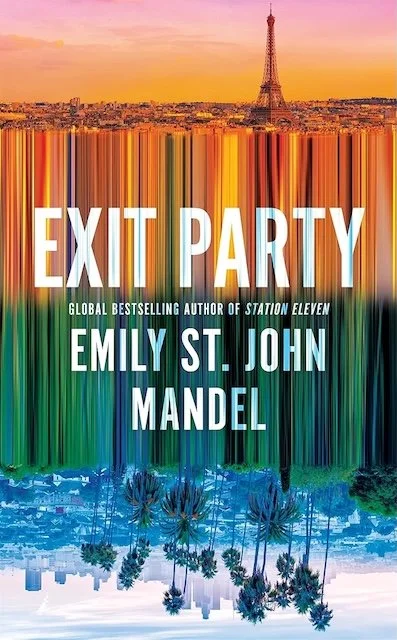
There’s only a handful of writers whose books I’ll preorder as soon as they’re announced, and Emily St. John Mandel falls into that category. Exit Party is her most ambitious yet: parallel worlds, domed cities, a party where there are more guests than there should be, and the return of a character I’d only just met in The Singer’s Gun.
The Party
The book centres on the “exit party” of the title. Ari, newly released after 18 years in prison, is entering a whole new world. It’s a different America she’s released into in 2031: a broken and dangerous place after a coup d’état, plagued by infighting among militias, with the shifting boundaries of city states and breakaway states.
Some slight stability has returned, and Ari has been invited to a house party in Echo Park, in the Republic of California, at the home of her housemate Gloria’s friend, Kareem. Ari, who has always experienced premonitions, has a feeling that something is going to “happen” at the party, and that she’s meant to be there. Indeed, something strange does occur. There seem to be “extra” people, and someone seems to vanish.
It’s this party that gives the book its name, and it’s where a “hinge moment” takes place that will resonate right through to the final pages. (I nearly used the word echo there again.) There are a couple of hinge moments in the book: those times when things change, decisions are made and time takes a different course.
But the resourceful Ari doesn’t have much time to dwell on the events of the party. The United States continues to fracture, and she finds herself on the move. Then, while she’s on a job, one of the partygoers reappears, and her sense of reality fractures.
Ari Waker, Back Again
We’ve met Ari before, in The Singer’s Gun. She wasn’t the main character, but you got a flavour of her. Back then she was a young woman who had made the decision to operate on the other side of the law. She and her cousin Anton were both raised in a family where corruption was the norm, but while Anton was trying to go straight, she was getting deeper into criminality and trafficking. She didn’t want the daily grind and through crime, she could achieve freedom. Trying to acheive that freedom meant that some of the decisions she made in that book led to her spending nearly two decades in prison.
Ari is an interesting one alright. Her tendency to operate outside the law gives her an edge, just as it did in The Singer’s Gun. She has an intuition that alerts her when things are about to take a bad turn, a useful attribute in this lawless world. In a place where the soundscape often involves gunfire in the distance this is a dangerous environment, and you have to be able to change with it. Though she does wonder how many separate lives she’s going to get before she runs out of chances.
But like the reader, she’s never quite sure about this new world.
Two Americas
There are other worlds too, familiar in name only: not the United States, but the United State. After all, as the book mentions a number of times, countries don’t last forever. Here, those who speak of democracy are seen as the enemy. There’s no need to worry about pesky things like voting in this world, as the president’s son just takes over.
Facial recognition is everywhere. There are work camps, detention centres, desert prisons where you’re never seen again, and state orphanages for the children of the disappeared. If the first world was about chaos, this one is very much the opposite:
The opposite of order is harmony. Peace is achieved through surveillance. Service is the surveillance department of the state. Harmony at any cost.
One of the ways the book excels is that this surveillance world feels close by, as if we already have one foot in it. It’s marketed as science fiction, but the United State feels all too believable in terms of where it feels many societies are heading. The erosion of civil liberties and the creeping authoritarianism feel like chapter one.
That’s not to say there isn’t hope in this book. Maybe there’ll be enough people to fight back against it from within the system.
I think one of the things about the two worlds in this book is that both are believable. As I write this, Americans have voted in the November 2026 midterms, and I was finishing the book as the results came in. I just wondered: is this another hinge moment?
One of the questions asked is - is it better to live in a lawless world which is chaotic and dangerous but you are essentially free, or one in which you have freedom and safety but live under constant surveillence?
Domes and Shifting Sands
There’s a dome, not over a moon colony as in Sea of Tranquility, but this time over a city: Paris. It’s more “a series of giant soap bubbles”, meant to protect against extreme weather and attacks, and it draws protests. The weather inside the dome can be modelled on a previous version of Paris; If there’s a deadly heatwave outside, you can always turn the temperature down 10 degrees and bask in the much more pleasant summer of Paris ‘97.
In this world, it feels like they’re trying to minimise disaster. Killer storms, civil wars, dirty bombs and wildfires are all mentioned. The dome isn’t there to make things better, only to insulate people as best it can. “Societal breakdown can be exhausting,” says one character.
Readers familiar with Mandel will recognise the feeling that underpins a lot of her books: shifting sands. Nothing feels permanent. Everything feels like it’s about to come undone. For me, nobody taps into the underlying anxiety we feel about the future like Mandel.
Writing Style
How best to describe Mandels prose to the uninitated? I find it so elegant, and it has this ethereal, dreamlike quality. One of her particular strengths is dialogue, it has this clipped tone and intimacy to it that I really like.
I was intrigued with the story and eager to see where it lead, but she’s one writer where I don’t get completely bogged down in the intricacies of the plotting. The way she weaves words has me under a spell - she can meander as much as she wants as far as I’m concerned.
Mandel’s Expanding Universe
Swan Dive, a painting featured in The Glass Hotel, turns up here too. You don’t have to have read The Glass Hotel or The Singer’s Gun, but if you’re a fan of Mandel, I think it will enhance your appreciation of her “worlds”. Maybe she’s building her own Marvel-style universe here.
The Lola Quartet is on my TBR pile and then I will have have read all of her works. I think it may be time for a re-read of her three most recent books after that, with maybe a short break for some other authors first.
Final Thoughts
It’s an ambitious book: a world of parallel universes, societal breakdown, domes over cities and ghosts. One character wonders about losing your whole world when countries collapse. If you live long enough, you become a migrant from another timeline; The world you learnt to navigate as you entered adulthood starts to slip away. You’re left behind, but that world is gone.
Thoroughly enjoyed this. Station Eleven and Sea of Tranquility remain top tier for me, but I’d be keen to see what others felt in the comments below.