

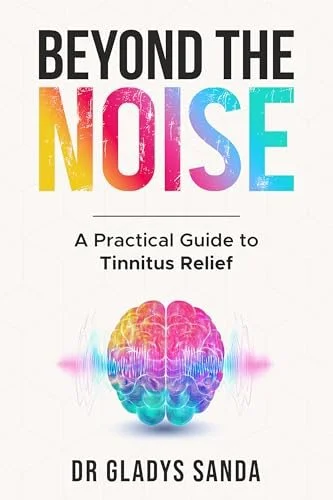
Beyond the Noise: A Practical Guide to Tinnitus Relief by Dr Gladys Sanda
My Tinnitus
I think everyone has their own way of describing their tinnitus. Mine is like the sound you got on one of those old FM radios when you were tuning between stations. Poor sleep makes it worse, but tinnitus causes poor sleep (I’ve written about this in my best books for insomnia list). See the problem there?
It’s hard to put an exact time on when it started, but I’d say five years now. At first it came and went, before I noticed it was there for hours at a time. Now it’s here permanently, in varying degrees of loudness. It’s part of my sound scape now, in the background of everything I hear.
I have a variety of tinnitus triggers: poor sleep, coffee, salt, sugar, alcohol, loud noises, constant background noise… and sometimes it’s bad even when I’ve had a good night’s sleep. I’ve quit caffeine and it made little difference -the others I find hard to avoid, though I’ve cut back at times to lessen the impact.
How I Came to This Book
I was introduced to this book by an audiologist. I wear hearing aids, and although I’m reasonably happy with the set I have, they’re six years old, so I wanted to see what improvements had been made and maybe think about an upgrade.
Tinnitus and hearing loss are interlinked, as the book describes. My hearing loss is quite mild, but the tinnitus makes hearing more difficult. I can’t detect certain frequencies, so that’s where the hearing aids come in. They help making sounds and speech clearer, meaning the brain has to strain less.
(I feel my tinnitus would be a lot worse were it not for my hearing aid. If you’re reading this and feel that your hearing loss is only mild - honestly, at least try one out and see if it makes a difference. I put it off far too long, and I can’t tell you the difference it has made, especially in social situations. I used to blame tinnitus for not being able to hear what people were saying, because it was so loud - in reality, the brain was focusing on it because it couldn’t hear other frequencies.)
My audiologist advised me to buy this book rather than upgrade my hearing set-up, as an upgrade wouldn’t have made much difference. That’s quite a saving: £2,000 for the set I was looking at, against the £10 or so the book cost. He’d been recommended the book himself at an audiology conference, so it comes highly rated.
About the Author
Dr Gladys Sanda is a Clinical Doctor of Audiology based in London. She lives with tinnitus herself (I don’t like the phrase “suffers from”), and it has become her greatest teacher of all. So she’s well placed to write this book.
What’s in the Book
It’s divided into three parts.
Part One is about what tinnitus is: tackling various misconceptions, the different types and the possible causes. I found it particularly interesting to read about how the brain creates tinnitus sounds, which added to my understanding of it. It also delves into the emotional impact of tinnitus, something I haven’t seen written about before.
Part Two is about neuroregulation, meaning practical strategies to calm the nervous system and reduce tinnitus distress. It was good to see self-compassion written about here, as I think it’s incredibly important when it comes to tinnitus. It’s something that can really wear you down, especially when it’s affecting my sleep. I didn’t choose to have it, and it’s not my fault. All I can do is learn how to habituate to it.
Some days I don’t feel like reading because I feel my concentration is poor. Or I choose not to have a noisy night out, because I know the noise and alcohol will make it really hard to live with for a couple of days. a quiet night in, when my auditory system feels overstressed, helps it to settle back down a bit. Periods of calm help me to habituate.
Part Three concerns neuroplasticity: building resilience, CBT and acceptance. I’ve tried CBT for sleep and it didn’t really work for me, but I can see its usefulness. Stress management is something I’m over-familiar with at this stage of my journey.
What I Liked
It’s well written and conversational in tone, and you really get the sense that Dr Sanda really knows what she’s talking about. I also liked the patient stories, which added depth to some of the concepts. I liked how it’s organised, and broken down into sections with a round up of the key takeways in each chapter.
Throughout there are strategies that come with practical tips you can use, and there are plenty of them for learning to deal with the stress around tinnitus. One of them, combining a body scan with a technique such as 4-7-8 breathing, is one that has helped me remain grounded during a time when tinnitus is particularly intense.
I hadn’t thought of using acceptance and commitment therapy (ACT) , and I can see how it can help with the emotional impact of tinnitus. It’s easy to withdraw from activities you previously enjoyed, and become more socially isolated. It’s important to focus on your wellbeing, and keep doing what makes you happy. You can’t shape your life around tinnitus.
It’s also a compassionate book, and you feel the author just gets it -there’s a lot of empathy throughout. Struggling with tinnitus can leave you in a lonely place, and it’s good to read a book by someone with a genuine understanding of the condition.
Tinnitus Frustration
If I had an issue with this book, and it’s to do with me, it’s that I was already familiar with a lot of the concepts. I’d come across most of these strategies before, through previous reading, YouTube watched at 5am, podcasts and deep dives on reddit. But that’s my problem.
If I was frustrated, it’s because I’m always looking for that silver bullet: the one method I haven’t tried that can bring relief when my tinnitus has felt unbearable for a stretch of time. That’s just my brain thinking it can “solve” the tinnitus. But it can’t.
I’ve lost count of the amount of times I’ve been told there’s no miracle cure for tinnitus, as if you should just lose hope and accept that nothing can be done. This books shows that there are lots of evidence based treatments you can use to filter the sound into the background so that it doesn’t bother you - habituation as it is known.
Who is this book for?
I wish this book had been around five years ago, so if you’re new to tinnitus everything you need is here. It really helps with understanding tinnitus, its causes and how the brain operates, and that knowledge helps. Discovering many of the stategies to deal with the stress around tinnitus would have been a major help to me early on.
If you’re like myself and have had tinnitus for a while, and feel like you’ve heard everything there is to know on the subject, you’ll still find something useful in here. Dr Sando brings plenty of experience to the subject, and there’s just so many perspectives and tools that you can use.
Tinnitus, Insomnia and Non-Duality
A lot of this I’d already met while dealing with insomnia, and in some non-duality and meditation reading. Acceptance is a big one, as is self-compassion with insomnia. Working with beliefs comes from non-duality and the work of Angelo DiLullo. They’re all interlinked.
Learning to live with tinnitus is something I’ve become good at in the five or so years since it developed and worsened. Occasionally it annoys me, but I don’t feel as much frustration or despair anymore. I don’t arrange my life around it.
I use it as a meditation object. If I listen closely, I can notice variations in the tone. If I’m doing natural meditation, it’s there along with whatever other sounds or sensations are occurring. It works in enquiry too: what is it that’s noticing, or hearing, the tinnitus? That’s not always easy when it’s blaring first thing in the morning, but I generally don’t react to it now.
That doesn’t mean it isn’t wearying. I feel like I’m stuck in an infinite loop. The tinnitus is made worse by lack of sleep, and the lack of sleep sometimes feels like it’s caused by my brain being woken by it at 4.30am. I always notice how it’s blasting at that time. Is it the tinnitus that wakes me? Honestly, I’m not sure.
Final Thoughts
Habituation is the key buzzword in this book. It’s the process by which the brain learns to filter out the tinnitus sound, so it fades into the background and becomes less intrusive. It really means not letting tinnitus dominate your experience, and I think it’s one of the main takeaways from this book.
It’s the only thing that has worked for me, and there’s plenty of tips in this book to do the same for you.
If someone told me they’d just began to experience tinnitus, this is the book I would give them. It’s written by someone with both knowledge and experience of the condition, and it has the understanding, the coping strategies and emphasis on habituation all in one place.
If you’re feeling despair, this book can bring you hope.
*I’m a book blogger, so if you are struggling with tinnitus, see an audiologist or your GP.
Published November 3, 2025
185 Pages
Beyond the Noise is also available on Audible, narrated by Nicky Griffiths. If you’re weighing up which audiobook service to use, see my audiobook subscription comparison.